
Nine-provider pricing and renewal study
How Much Does a VPN Cost? Pricing and Renewal Study
In our August 14, 2026 U.S./USD check, true month-to-month VPN prices among nine providers ran from $9.00 to $16.45. Long-term offers advertised much lower $2.00–$4.99 monthly equivalents, but the first charges were $56.94–$119.76 upfront. Seven of nine effective monthly rates increased at the checked renewal.
- 4 of 9 VPNs more than doubled their effective monthly rate at renewal: NordVPN +232.1%, PrivateVPN +200.0%, Surfshark +164.4%, CyberGhost VPN +116.7%.
- Median renewal change across all nine: +85.4%.
- Smallest changes: Private Internet Access +8.3%; Turbo VPN and VPN.ac stayed flat.
Free to use: quote these findings or reuse our pricing dataset (CSV) with a link to this page, under CC BY 4.0.
Evidence note: The dated pricing rows are Evidence Level 1 — official-source editorial review, supplemented by ReviewsAlly’s paid-account research where it clarified a public term. Our wider provider reviews reached Evidence Level 4 — paid workflow review, but we did not buy every long-term offer or wait years to observe every renewal charge. Prices, taxes, currencies, promotions, and checkout terms can change. See how ReviewsAlly tests VPNs. Reviews Ally may earn a commission when you use some links elsewhere on our site. Read our advertising disclosure.
Use this page to
Turn a promotional VPN price into an actual billing timeline
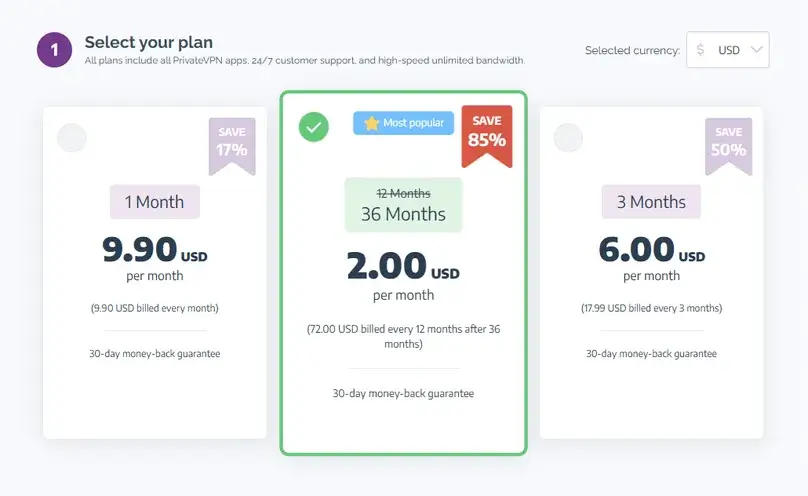
A VPN can honestly advertise “$2.00 per month” and still charge $72 today. The first number is an average over the included access period; the second is the invoice. This study keeps five price objects separate: the true monthly plan, the advertised long-term monthly equivalent, the first total charge, the effective first-term rate, and the renewal rate.
Model your own offer
Enter a plan’s first charge, included months, renewal cycle, and time horizon without sending those values anywhere.
Compare nine base tiers
Put monthly, promotional, upfront, access-period, and renewal figures in the same dated table.
See the renewal step
Compare effective monthly rates on one shared scale instead of comparing unrelated billing totals.
Plan a longer horizon
See the full renewal invoices needed to buy enough coverage for 24, 36, or 60 months.
Download the data
Audit the raw fields, derived columns, formulas, source URLs, and public evidence notes in CSV format.
Private calculation · no account or payment details needed
VPN Cost and Renewal Calculator
Choose one of the nine dated study presets or enter a custom offer. The calculator shows what the first term really averages, how renewal changes the effective rate, and how many complete renewal invoices are required for your selected horizon. It never prorates a renewal that the plan itself bills as a full cycle.
Choose a preset or enter the plan terms, then calculate. Results are estimates from the numbers you provide—not a quote or a prediction of future prices.
The short answer
How much does a VPN cost per month?
A paid VPN can cost about $9 to $16.45 if you buy one month at a time, based on the nine base tiers in this U.S./USD study. Their checked long-term offers advertised $2.00 to $4.99 per month, but none of those offers meant a $2–$4.99 monthly debit. The providers charged the first term upfront, from $56.94 to $119.76.
Those ranges are a dated sample, not a market-wide minimum or maximum. They exclude free plans, antivirus and identity bundles above the base tier, business products, app-store pricing, optional Dedicated IPs, taxes, and currency-conversion costs. The median true monthly price was $11.99; the median promoted monthly equivalent was $2.49; and the median first charge was $79.
Read a VPN price in this order
- Tier: confirm that two providers include comparable VPN features.
- Amount due today: this is the cash-flow number, even when the ad leads with a monthly average.
- Initial access: add paid and bonus months before calculating the first-term rate.
- Renewal total and term: normalize both to a monthly rate before comparing them.
- Tax and add-ons: keep them outside the base-plan comparison unless both sides include them.
U.S./USD public consumer view · checked August 14, 2026
VPN price comparison: monthly, upfront, access, and renewal
This is a research table, not a ranking. We selected the base paid consumer VPN tier that could be compared without optional add-ons or broader security bundles. “Advertised / month” is the provider’s displayed long-term average. “First effective / month” is our calculation from the full first charge divided by all initial access months.
| Provider / base tier | True monthly plan | Advertised / month | Due today | Initial access | First effective / month | Renewal total / term | Renewal effective / month | Rate change |
|---|---|---|---|---|---|---|---|---|
| CyberGhost VPNCyberGhost VPN | $12.99 | $2.19 | $56.94 | 26 months 24 paid + 2 bonus | $2.19 | $56.94 / 12 mo. | $4.75 | +116.7% |
| NordVPNBasic | $14.99 | $3.49 | $94.23 | 27 months 24 paid + 3 bonus | $3.49 | $139.08 / 12 mo. | $11.59 | +232.1% |
| Private Internet AccessPIA VPN | $11.95 | $2.03 | $79.00 | 39 months 36 paid + 3 bonus | $2.03 | $79.00 / 36 mo. | $2.19 | +8.3% |
| PrivateVPNPrivateVPN | $9.90 | $2.00 | $72.00 | 36 months 12 paid + 24 bonus | $2.00 | $72.00 / 12 mo. | $6.00 | +200.0% |
| Proton VPNVPN Plus | $9.99 | $4.99 | $119.76 | 24 months | $4.99 | $83.88 / 12 mo. | $6.99 | +40.1% |
| PureVPNStandard | $12.95 | $2.15 | $58.20 | 27 months 24 paid + 3 bonus | $2.16 | $47.95 / 12 mo. | $4.00 | +85.4% |
| SurfsharkStarter | $16.45 | $2.49 | $67.23 | 27 months 24 paid + 3 bonus | $2.49 | $79.00 / 12 mo. | $6.58 | +164.4% |
| Turbo VPNGold | $11.99 | $3.33 | $89.99 | 27 months 24 paid + 3 bonus | $3.33 | $89.99 / 27 mo. | $3.33 | 0.0% |
| VPN.acVPN account | $9.00 | $3.75 | $90.00 | 24 months | $3.75 | $90.00 / 24 mo. | $3.75 | 0.0% |
Rounding note: PureVPN’s $58.20 divided by 27 months is about $2.16, while the provider’s displayed $2.15 headline is within one-cent presentation rounding. Taxes are excluded because they can vary by checkout location. “Rate change” compares effective monthly rates, not total invoice sizes.
Two numbers, two units
What the ad says vs. what the card sees
The advertised monthly figure answers, “What does the full initial term average per month?” The upfront figure answers, “What leaves the payment method now?” They cannot share one honest axis because one is dollars per month and the other is total dollars. The two panels below keep the same provider order but use separate scales.
Advertised monthly equivalent
USD per month · panel maximum $4.99
Amount due today
Total USD · panel maximum $119.76
The bar length is meaningful only inside its own panel. Visible labels carry the exact values.
View accessible chart data
| Provider | Advertised / month | Due today |
|---|---|---|
| PrivateVPN | $2.00 | $72.00 |
| Private Internet Access | $2.03 | $79.00 |
| PureVPN | $2.15 | $58.20 |
| CyberGhost VPN | $2.19 | $56.94 |
| Surfshark | $2.49 | $67.23 |
| Turbo VPN | $3.33 | $89.99 |
| NordVPN | $3.49 | $94.23 |
| VPN.ac | $3.75 | $90.00 |
| Proton VPN | $4.99 | $119.76 |
Normalize the next bill
What happens to the effective monthly rate at renewal?
Seven of the nine checked offers moved to a higher effective monthly rate at renewal. The median increase among all nine rows was 85.4%. That does not mean every renewal invoice was larger than the first invoice: the initial and renewal terms can have different lengths. Dividing each total by its own included months is what makes the comparison meaningful.
USD per month · shared maximum $11.59 · sorted by percentage increase
$11.59
$6.00
$6.58
$4.75
$4.00
$6.99
$2.19
$3.33
$3.75
Each provider has two bars on the same scale: first term above, renewal below. Rates are calculated from the totals and term lengths checked on August 14, 2026.
View accessible renewal-chart data
| Provider | First term | Renewal | Change |
|---|---|---|---|
| NordVPN | $3.49 | $11.59 | +232.1% |
| PrivateVPN | $2.00 | $6.00 | +200.0% |
| Surfshark | $2.49 | $6.58 | +164.4% |
| CyberGhost VPN | $2.19 | $4.75 | +116.7% |
| PureVPN | $2.16 | $4.00 | +85.4% |
| Proton VPN | $4.99 | $6.99 | +40.1% |
| Private Internet Access | $2.03 | $2.19 | +8.3% |
| Turbo VPN | $3.33 | $3.33 | 0.0% |
| VPN.ac | $3.75 | $3.75 | 0.0% |
NordVPN had the largest percentage step in this snapshot because its 27-month introductory access averaged $3.49, while the checked $139.08 annual renewal averaged $11.59. Turbo VPN and VPN.ac showed no effective-rate change in the terms we recorded. Those are dated comparisons, not promises about what any account will be offered later.
Cash flow, not fractional months
What 24, 36, and 60 months of coverage can require
Subscription renewals normally arrive as complete invoices. To model a 60-month horizon, we add full renewal cycles until purchased coverage reaches or passes month 60. We do not pretend that an annual $79 renewal can be bought eleven months at a time. That is why coverage sometimes exceeds the target.
| Provider | 24-month horizon | 36-month horizon | 60-month horizon |
|---|---|---|---|
| CyberGhost VPN | $56.94 / 26 mo. | $113.88 / 38 mo. | $227.76 / 62 mo. |
| NordVPN | $94.23 / 27 mo. | $233.31 / 39 mo. | $511.47 / 63 mo. |
| Private Internet Access | $79.00 / 39 mo. | $79.00 / 39 mo. | $158.00 / 75 mo. |
| PrivateVPN | $72.00 / 36 mo. | $72.00 / 36 mo. | $216.00 / 60 mo. |
| Proton VPN | $119.76 / 24 mo. | $203.64 / 36 mo. | $371.40 / 60 mo. |
| PureVPN | $58.20 / 27 mo. | $106.15 / 39 mo. | $202.05 / 63 mo. |
| Surfshark | $67.23 / 27 mo. | $146.23 / 39 mo. | $304.23 / 63 mo. |
| Turbo VPN | $89.99 / 27 mo. | $179.98 / 54 mo. | $269.97 / 81 mo. |
| VPN.ac | $90.00 / 24 mo. | $180.00 / 48 mo. | $270.00 / 72 mo. |
These are mechanical scenarios using the checked renewal terms as if they remained unchanged. They exclude tax, add-ons, refunds, later promotions, retention offers, mid-cycle plan changes, and price changes. They are planning estimates—not future invoices.
Commitment is part of the price
Monthly vs. annual vs. multi-year VPN plans
The cheapest average rate is not automatically the best purchase. A longer plan trades flexibility and cash today for a lower first-term average. The sensible term depends on how certain you are about the provider, whether the needed app features work on your devices, and whether the upfront charge fits your budget.
| Plan type | Usually strongest for | Main trade-off | What to verify |
|---|---|---|---|
| True monthly | Short projects, travel, uncertain fit, or keeping commitment low | Highest average rate in this sample | Whether cancellation stops the next monthly charge and whether the tier matches longer offers |
| Annual | Users who already know the apps and expect about a year of use | Larger first invoice and less flexibility | Total due, annual renewal, refund eligibility, and tax |
| Multi-year | Established fit and a budget that can absorb the upfront total | Longest commitment; promotional rate can differ sharply from renewal | Paid vs. bonus months, next renewal date, renewal term, and later rate |
| Free plan or trial | Testing compatibility before committing, when the limitations fit | Feature, server, device, time, or automatic-conversion limits | Payment method, trial deadline, next charge, and billing owner |
If you have not tested the service on the devices and networks that matter, consider the true monthly plan, a legitimate free plan, or a clearly understood trial path before locking in multiple years. Our VPN free-trial and money-back-guarantee comparison separates $0 trials, paid trials, ongoing free plans, and full-price refund routes.
The denominator matters
How bonus months change the advertised VPN price
Seven of the nine long-term offers included bonus months. A provider can charge for 24 months, add three months, and divide the first total by 27. That lowers the displayed monthly equivalent without lowering the amount due today. The math can be sound, but the access period must remain attached to the headline.
Bonus months are not cash. They are access time, and they may apply only to the introductory term. When the renewal period is shorter, the same total can represent a higher effective monthly rate. PrivateVPN is the clearest example here: $72 over 36 initial months averages $2, while $72 over each 12-month renewal averages $6.
The base-plan boundary
VPN costs that are not in our normalized base price
A clean base-tier comparison is useful only if it says what was left out. Your final checkout can be higher, lower, or simply structured differently for reasons that are not captured by the advertised VPN rate.
Taxes
Sales tax, VAT, GST, or another location-based charge may appear after billing details are entered. We excluded taxes rather than treating a screen without a displayed tax as universal.
Currency and card fees
Exchange-rate spreads, foreign-transaction fees, and local-currency pricing can change the amount that reaches your statement.
Higher bundles
Password managers, antivirus, identity monitoring, data removal, cloud storage, and family products can sit above the base VPN tier.
Optional add-ons
Dedicated IP, alternative phone numbers, port-forwarding products, and extra business features should be priced separately.
App-store pricing
Apple, Google, Microsoft, or another store can have different plan availability, billing ownership, prices, taxes, and refund rules.
Later plan changes
Upgrades, downgrades, retention offers, account-specific promotions, and future list-price changes are outside this fixed snapshot.
If a stable personal address is the reason your bill is higher, compare the add-on separately in our Dedicated IP vs. shared VPN IP guide. Do not fold an optional Dedicated IP into one provider’s base price while leaving it out of another’s.
Before the payment button
Eight VPN price fields to save before subscribing
A good final sentence is: “I will pay [total] today for [access months], then [renewal total] every [renewal months] unless I cancel.” If the checkout does not let you complete that sentence, pause and find the controlling terms or ask support for an objective clarification.
A reproducible dated study
How ReviewsAlly calculated VPN costs
We froze this public comparison on . The scope was nine providers already covered by ReviewsAlly’s paid-review program, using the U.S./USD public consumer pricing view and the lowest comparable paid base VPN tier. We excluded free plans, business products, app-store variants, higher bundles, optional add-ons, and taxes from the normalized price columns.
Normalization formulas
Initial access months = paid months + bonus months
First-term effective monthly rate = amount due today ÷ initial access months
Renewal effective monthly rate = renewal total ÷ renewal term months
Renewal change = (renewal effective rate ÷ first-term effective rate − 1) × 100
Full renewal cycles needed = maximum of zero and ceiling((horizon − initial access) ÷ renewal term)
Cash paid = first total + (full renewal cycles × renewal total)
We calculate with the unrounded totals and term lengths, then display money to two decimal places and percentage changes to one decimal place. A provider’s displayed monthly equivalent can differ by one cent because pricing cards may round or truncate the intermediate value. We treat a headline as reconciled when the full total and included months reproduce it within ordinary cent-level presentation rounding.
For 24-, 36-, and 60-month horizons, we add whole renewal cycles until the purchased access reaches the target. We do not prorate renewals unless the provider actually sells a prorated cycle. The public CSV preserves both the target horizon and the resulting purchased coverage so that extra months are visible.
What this study can and cannot establish
Pricing-study limitations
VPN pricing is volatile. A provider can change a promotion, bonus-month count, tier name, renewal term, currency, tax treatment, checkout path, or eligibility rule after our freeze date. Some sites personalize pages by location, campaign, device, account status, or test variant. This study records the checked public U.S./USD view; it does not claim that every visitor will see the same offer.
We did not buy all nine long-term plans and wait through their full introductory periods. Renewal figures are the terms shown or confirmed at the check, not charges we observed years later. The 24-, 36-, and 60-month amounts assume those renewal totals and cycle lengths stay unchanged, so they are scenarios rather than forecasts.
As we completed the first VPN reviews, our methodology became more detailed. That created small differences in how older pricing screenshots, checkout observations, and account notes were captured across providers. The underlying records are genuine, the current rows were rechecked to one release date, and every public calculation can be reproduced from the dataset. More resources would let us repeat purchases across more regions and observe real renewals over several years; we do not reduce substantial paid-account work to “unreliable” merely because the project can still improve.
This is not tax, accounting, legal, or financial advice. It is a consumer billing comparison. Always use the final checkout and controlling terms for your own country, currency, payment channel, and account.
Open calculations
Download the VPN pricing and renewal dataset
The public CSV contains 30 columns for the nine normalized plans: direct pricing fields, paid and bonus months, effective rates, renewal changes, full-cycle cash scenarios, country and tax scope, official source URLs, screenshot URLs, ReviewsAlly review links, and evidence notes. It contains no account, order, payment, support-ticket, identity, or bank information.
Download VPN Cost and Renewal Study — 2026 (CSV)
Dataset metadata
- Version: 2026-08-14
- Geographic view: United States public consumer pricing
- Currency: USD; no currency conversion
- Scope: Base paid VPN tiers; tax, add-ons, business plans, and app-store variants excluded
- License: ReviewsAlly editorial dataset; cite and link to this page when reused
Official pricing pages
Terms and renewal context
ReviewsAlly research trail
- How ReviewsAlly tests VPNs
- Nine-provider trial and refund study
- VPN speed-test and speed-loss guide
- Private Evidence Logs, dictated research, account records, and conflict notes; sensitive fields are not published.
Plain-English billing answers
VPN Cost FAQ
How much does a VPN cost per month?
In our August 14, 2026 comparison, true month-to-month prices for nine base paid VPN tiers ranged from $9.00 to $16.45. Checked long-term offers advertised $2.00 to $4.99 monthly equivalents but required $56.94 to $119.76 upfront. Taxes and add-ons were excluded.
Why does a VPN advertise $2 per month but charge $72?
The $2 figure is an average, not necessarily a monthly invoice. In PrivateVPN’s checked example, $72 bought 36 months of initial access, so $72 ÷ 36 = $2. The full $72 was the first-term charge.
Which VPN was cheapest in this study?
Among the specific base tiers checked, VPN.ac had the lowest true one-month price at $9, while PrivateVPN had the lowest advertised and effective first-term rate at $2. Those are different price questions, and neither alone establishes the best value, app quality, or fit.
Do VPN prices increase after the first term?
Often, but not always. Seven of nine rows had a higher effective monthly rate at the checked renewal; Turbo VPN and VPN.ac were unchanged. Renewal terms can change later, so verify your own next total and billing period.
Is an annual or multi-year VPN plan always cheaper?
It usually lowers the initial average in this sample, but it requires more cash upfront and creates a longer commitment. The right comparison includes the amount due, refund terms, feature fit, renewal rate, and how likely you are to use the full access period.
What are bonus months in a VPN offer?
Bonus months extend the initial access period without changing the stated first charge. Providers may include them in the denominator used for the advertised monthly equivalent. They may not repeat at renewal unless the renewal terms explicitly say they do.
Are taxes included in these VPN prices?
No. We excluded taxes from the normalized figures because the applicable amount can depend on checkout location and billing details. Your final total may include sales tax, VAT, GST, or another charge.
Does the study include Dedicated IP or antivirus add-ons?
No. We compared the base paid consumer VPN tier. Dedicated IP, antivirus, identity tools, data removal, alternative numbers, business plans, and broader bundles were excluded unless they were inseparable from the selected base tier.
Why can purchased coverage exceed my calculator horizon?
The calculator adds complete renewal cycles because subscriptions are normally billed in full terms. If you need 36 months after a 27-month first term and the renewal is annual, one full renewal buys 39 months of total coverage. The tool does not invent a nine-month prorated invoice.
Does canceling a VPN change the first charge?
Canceling generally stops a future renewal; it does not automatically prorate or refund the current term. Refund eligibility is a separate question controlled by the provider, billing channel, timing, and terms.
Does the calculator send or save my plan details?
No. Its code runs in your browser and does not transmit or store the values you enter. It also asks for no account, payment, order, or identity details. Standard page-level analytics, if present on the site, are not configured by this calculator to capture field values.
Can I use the calculator for euros, pounds, or another currency?
Yes, if every amount you enter uses the same currency. The selector changes the visible label only; it does not fetch exchange rates or convert values.
Are the 60-month totals guaranteed future costs?
No. They are scenarios that hold the August 14, 2026 renewal totals and terms constant and add complete cycles. Providers can change prices, promotions, tax treatment, terms, or account-specific offers before a future renewal.
How often should VPN pricing be rechecked?
We recommend a formal recheck at least every three months, plus an immediate check when a provider changes a pricing page, tier, checkout, bonus-month count, or renewal disclosure. Buyers should always verify the final checkout on the day they subscribe.
The practical rule
Compare the invoice first, then decide whether the commitment earns its discount
A useful VPN price is one you can translate into cash today, months of access, and the next complete bill. The promotional average tells part of that story; it should not be forced to carry the whole thing. Run the checkout terms through the calculator, save the dated evidence, and judge the provider on app fit and testing quality as well as price.
Compare our VPN top picks
Use our paid tests to compare speed, streaming, leaks, features, pricing, refund behavior, and the broader trade-offs.
Calculate before checkout
Use a dated preset or copy the current totals from your own checkout into the private browser-based calculator.